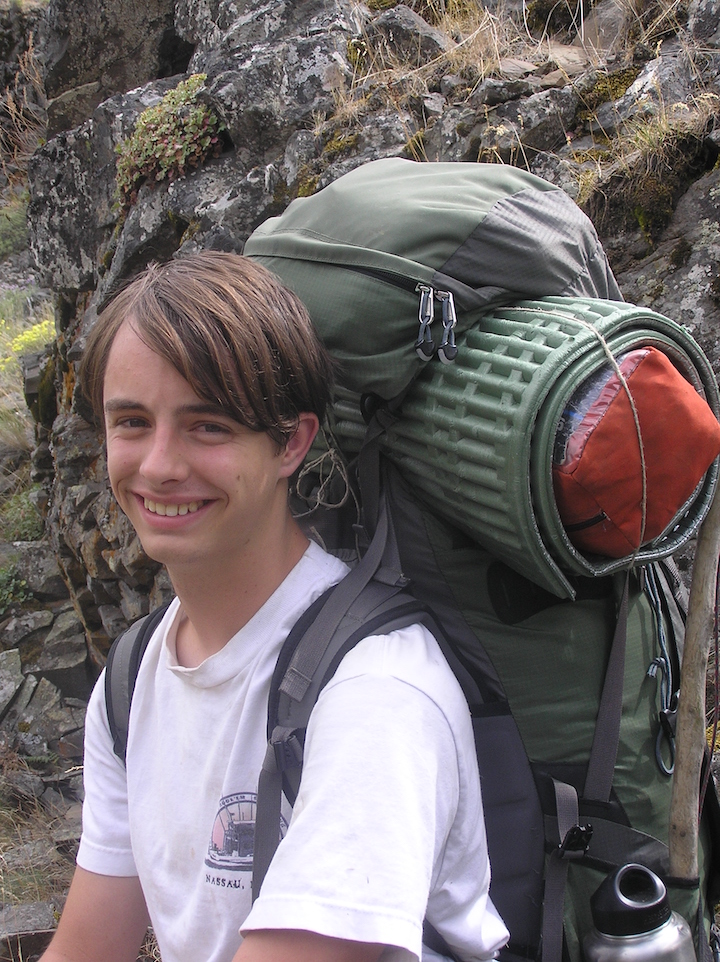
Calling all 20 something outdoor leaders! Don’t be like me. Realize that the neural insulation connecting our frontal lobes is not fully knitted until we are in our mid 20’s. I have been fortunate enough to stop and think before anyone under my care over the past 30 years ever got irreparably hurt. But on a deeper level, there were probably a few people I scared away from nature and outdoor recreation by pushing them through too-risky situations. The risks weren’t worth the educational benefits in those situations.
Habit of Engaging the Frontal Cortex
Just because our frontal lobes – the place where humans assess consequences of our decisions – do not fully form until we are older, does not mean that young people can’t make smart decisions. It’s just that young people have to develop a conscious habit of engaging their frontal lobes, rather than operating out of their brain stems – the place where animals operate out of instinct. Older people have survived to be 25 by developing this habit.
But even if you are older and your frontal insulation is fully formed, it can still be challenging to engage your frontal lobes if you are HALT: Hungry, Angry, Lonely, Thirsty; or Hurting, Alienated, Loving, or Tired. Just click on that last link for the science of this truth, and before making any decision of consequence, address any acutely HALT situation. In other words: eat if your blood sugar might be low; drink some water with electrolytes (so your sodium level doesn’t fall too much) if you feel a bit dehydrated.
Perceived vs Actual Risk
What makes risk worthwhile? Why take risks at all? Well, it’s all a matter of educational or other benefit. We would never step foot in an automobile – our greatest daily activity risk according to the CDC at 35,000 U.S. deaths in 2011 – or an airplane if it weren’t worth getting somewhere. And in outdoor settings, the benefits of learning something about nature, or achieving a spiritual awakening, or realizing that we are far more capable than we think – these are well worth the risks of being outside.
Note that exposure to toxins – at 33,500 U.S. deaths in 2011 – is our second greatest accidental risk, and if you add inhalation of smoke from fire to that, the number surpasses 36,000. So arguably, exposure to poisonous substances may be our greatest risk even outdoors, especially since it has a low perceived incident rate, but an actual high rate. This concept is critical to understand, as Paul Nicolazzo of the Wilderness Medical Training Center emphasizes in his risk management training courses.
Our next biggest risk outdoors has a high perceived risk rate, and a high actual risk rate: bonks and falls (at 27,000 deaths in city and wilderness in 2011) and it is definitely my biggest paranoia whenever leading groups. In fact, when I was younger, I remember leading groups up slopes and along ridges that I would avoid nowadays, unless securely roped-up. Futhermore, remember that it’s “bonks” and falls, meaning that whenever the wind picks up – get to a safe place. If you have ever been in the forest during a wind storm, you know exactly the kind of danger I’m talking about.
Unless water, or lack thereof, is an issue – then that’s my biggest paranoia when leading. There were 3,500 accidental U.S. drownings in 2011, for instance. Water threatens our biggest survival need – air, and water also threatens our second biggest need – the regulation of our body temperature. In other words, if you are wet, you will chill, and if you are dehydrated, you will not be able to regulate your temperature, and in heat stroke situations, you cannot reverse the problem in the field without cold water submersion and IV hydration.
Communication Plan & Incident Reporting
Most people think that communicating means being able to express one’s self. But that’s just a start. We have to learn to express in a way that people can hear, and more. Wikipedia has a nice summary of what communication entails, including:
- Thought: First, people need to have all the information and understand it.
- Expressing: Next, a message is sent to a receiver in words, actions, or other symbols that the receiver can fully understand.
- Listening: Lastly, the receiver translates the words or symbols into a concept or information that is what the sender truly meant.
As mentioned, things get difficult when we are HALT: Hungry or Hurting; Angry or Alientated; Lonely or Loving; Thirsty or Tired. That’s when having a practiced communication plan is critical. At the Wolf College, we practice facilitation skills and conflict resolution at the start of our summer trainings, and we have a protocol for communicating incidents as shown here:
Incident Report Form — Attach to Application Registration / Health History Form. Complete one form per incident. Fill out reverse and have all persons, including witnesses involved, attach signed and dated statements to describe the incident.
Name of Participant ____________________________________ Date ________________
Type of Incident (Behavioral, Accident, Illness, etc.) _________________________________
Date & Time of Incident ________________________________________________a.m./p.m.
What activity was the participant involved in at the time, and who was supervising the activity?
List any equipment that was involved in the incident:
Describe the sequence of activity succinctly including what the participant was doing, where the incident occurred (make a diagram to locate people and objects, and describe the terrain and its difficulty level), what emergency procedures were followed and whom was involved. (Attach paper, signed and dated, describing the incident in detail. Describe the weather, the patient’s disposition, and the position the patient was found in if relevant and how he/she was moved.)
What could the participant have done to prevent the incident?
Who (parents/guardian/emergency contact) was notified? ____________________________
Time & method notified and by whom? (Include relevant contact numbers) _______________
Describe the response of person/s contacted:
Which, if any, WOLF supervisor was notified? ______________________________________
Time & method notified, and by whom? (Include relevant contact numbers) ______________
Instructions given by supervisor:
Name and phone number of the participant’s family insurance company, our liability insurance company, or our accident insurance company that was notified for a claim:
Describe any contact/comments given to the media:
Name of Witness _____________________________________Phone _________________
Witness Address ____________________________________________________________
Witness Role _______________________________________________________________
Name of Incident Respondent Completing Form ____________________________________
Position in Wolf Camp _________________________ Signature ______________________
Addressing the FAF Factor – Transitions Planning
Besides a group’s level of happiness generally, the biggest test of whether you and your staff communicate well is during moments of transition: packing up to leave, unpacking the vehicles and getting the hike underway, setting up tents and running meals, for instance. Transitions take a lot of thought and pre-planning, then super clear communication, to avoid what our very first apprentice Kate Hedges coined as the FAF Factor: Farting Around Forever.
A big FAF Factor, or in other words, when it seems to take forever to make transitions, should be a huge “red flag” not only that your planning and communication is poor, but that you are risking serious injury. It’s more dangerous being around human-made equipment like vehicles, camp gear, etc. and that’s where transitions take place. So monitor your FAF Factor by timing your transitions, and shoot for progress, not perfection.
Preventing Brain Burps – Moving Site Mitigation
Now for moving site strategies: the term “moving site” was coined by Paul Nicolazzo of the Wilderness Medical Training Center who, to my knowledge and experience, offers the best training you can get on strategies for managing “moving sites” and for outdoor program risk management in general. What he calls “moving sites” are basically just activities which involve moving from one location to another. In other words, human-powered traveling activities.
Examples of moving sites are when a group of people hike from Point A to Point B. The question is, how are you going to manage that activity to “mitigate,” or reduce as much as possible, the risks? Maybe you will position the person with the most experience on the trail in front, and the person with the best “people” skills in back. Maybe the group leader needs to be in the middle.
Again, thinking ahead – planning – is key along with communication. But in the moment, we can experience Brain Burps that can lead to injuries. The cause, besides lack of planning and poor communication, is good ol’ HALT which is explained above. You want to know what the key to preventing injuries is in that case? Learning to SAY NO. In fact, this bit of advice is probably going to be your biggest take-home message, and it takes practice!
Empower yourself to HALT when you are a bit unsure of a current risk factor, and always encourage everyone around you to SAY NO or HALT when they don’t understand why a risk is being taken, and that the risk has been mitigated. Crossing a river or avalanche slope are obvious Moving Site activities which should allow veto power by every single person.
But what about hiking down a slope to a dry creek bed, and an inexperienced person in the group thinks it’s too risky? If you know it to be safe for everyone, you should take 20 minutes to listen to worries, and then describe the risk and its mitigation plan: perhaps in this case it’s just that people don’t know they are perfectly capable of going down there, and that there are no risks greater than anywhere else on the hike. That situation is exactly the time to practice saying HALT and honoring it – so that good habits are developed to prevent truly risky situations.
Transportation & Site Safety Plans
Muddling our definitions a bit further, let’s remember that we have to be concerned about 1) transition moments, 2) moving sites, and now: 3) stationary activity sites, and 4) transportation vehicle “sites.” Of course, transitions often take place at the same “stationary sites” where you do activities, and transport vehicles are moving, but they are really a distinct “location” you need to mitigate risks for.
In fact, in addition to the dangers of being on the road in general, one of the most dangerous vehicles you can use is a passenger van which carries more than 8 people. Check out http://www.dmv.org/how-to-guides/safety-and-driving.php for suggestions on how to mitigate their risks, and http://www.nsc.org/pages/home.aspx for creating a comprehensive driver safety plan.
Finally, you need to develop risk management plans for each of the “stationary sites” you plan to locate activities.
Equipment & Food Safety Plan
We have policies that cover many eventualities, with equipment and food safety. To address the latter issue, just get a food handler’s permit and you’ll have most of what you need. We also require that anyone handling food receives training in sanitation, menu planning, food preparation and protection, and hygiene. These things seem like no-brainers, but it turns out that 95% of our staff under the age of 30 don’t have a clue about how to clean a bathroom or kitchen, let alone food preparation.
Remember that being around human-made equipment is the most dangerous place to be, and further, that “transitions” usually involve lots of equipment. The only place anyone has ever been close to severe injury (cuts, concussions, etc) at Wolf Camp has been around equipment used during transitions: playground equipment while waiting for rides, but also garden tools , construction tools, and of course survival tools like knives. You should have an equipment safety use procedure and training for every significant item you encounter in the field. Here’s one example:
Wolf Camp Knife Safety Training
- Demo how to hold knife properly in sheath. Secure in sheath, in bag, if in vehicle.
- Demo how to pass knife safely.
- Demo how to put knife in and take knife out of sheath safely.
- Demo how to enforce the knife safety zone.
- Demo how to sit when working with knife
- Demo how not to leave knife on ground unattended and without a sheath
- Demo how turning object around so you are always cutting away from you, commonly known as never cutting toward yourself.
- Demo how not to cut on or over legs or into the ground. Get a big piece of wood to carve into if necessary.
- Demo how to always have the hand that is holding the object be above the knife. See if you can do this when carving a hole into a bow-drill hand-hold.
- Demo how to keep finger always behind guard.
- Demo how to make little cuts rather than large gouges, use thumbs on back of blade, etc.
- Demo how to test for sharpness properly, aka perpendicularly.
- Demo how to always take plenty of breaks and always HHAALLTT or otherwise losing awareness.
- Demo how to administer first aid for knife cuts.
- Test ability to carve a knot off safely;
- Test ability to split kindling;
- Test ability to score and break a stick;
- Test ability to carve a simple design;
- Test ability to sharpen a knife.
Top Hazards Mitigation Plans (Falls/Strikes, Water, Toxins)
Falls & Strikes: For an excellent article on “Hiking Meetups” Safety which points out that the one factor which should be the cause of most trip cancelations (other than treacherous driving conditions) is wind hazard which is well described by Seattle Backpackers Magazine. There’s also a good description of how to prevent slips and falls here. Finally, you can develop a mitigation plan for avoiding falls by clicking here.
Swimming & Other Water Activities: Open water safety tips and training is not widely available, but there are starting to be a few resources online, including ACA Water Safety Training & Tips from the American Camping Association and some excellent LA City Lifeguard information for ocean beaches from the City of Los Angeles. Finally, it’s critical to create a Wading Safety plan since accidents often happen along the shore, so start here and here.
Avoiding Poisons & Other Toxic Intakes: To develop a mitigation plan to avoid poisons and other toxins, the U.S. Center for Disease Control has the best resources, including avoiding poisonous plants, avoiding household poisoning here and here.
Environmental Threats & Emergency Response Procedure
There are many environmental health threats. To understand what they are, go to http://www.wildmedcenter.com/1/category/environmental%20hazards/1.html and take a Wilderness First Aid course to help make yourself aware of these threats, as well as how to treat health issues which result from them. The following is my procedure which can be applied to any kind of emergency:
Wolf College Health Emergency Response Procedure
1. Clear everyone of any imminent hazards (see, hear, smell) and evacuate the uninjured to safe zones. (pre-determined if at camp)
2. Determine number of victims and relieve any patients of further injury, following the ABCs: (things that can possibly be done without first aid kit)
- Clear Airway and Ensure Breathing. (perform hymelick, CPR, etc. if needed)
- Maintain Circulation (stop bleeding, ensure blood flow to vital organs, get defibralator if needed)
- Treat Severe Emergencies (prevent further spinal injury, reverse anaphlactic shock, warm hypothermic patient, cool heat injuries, prevent imminent infections, sedate violent perpetrator, etc.)
3. If the incident is an emergency that merits a 911 call, ensure that someone responsible:
- Can reach a working phone and call 911. (describe how/where)
- Can describe the problem. (chief complaint, who the patient is, mechanism of injury)
- Can give directions to your location. (directions to Wolf Camp are posted by phone)
- Can communicate back to you and coordinate meeting ambulance. (at top of driveway at camp)
4. Have responsible person contact the highest ranking first aid trained staff member plus Chris Chisholm if on site. (one of the latter two should contact patient’s emergency contacts (i.e. parents if minor) as soon as appropriate, and if necessary, have them meet patient at the hospital, or if appropriate, receive instructions on what to do with patient)
5. Have responsible person contact retrieve needed supplies (carried by lead instructor or by assistant instructor if assistant has greater emergency medical training, plus extra supplies located in camp first aid room or in vehicle) including:
- First Aid Kit (remember rubber gloves and pen/pencil)
- Camp Registration Form (i.e., patient health history and emergency contact info)
- Incident Report Form (with s.o.a.p. notes on reverse)
(6. Move patient only if necessary and only trained to mitigate risk for further injury, such as securing spine: tell patient who you are and what you are doing to gain compliance: and inspect from head to toe for more signs, symptoms, and otherwise unnoticed injuries. Treat patient according to your professional medical training until patient is turned over to professional medical personnel.)
7. Clearly communicate the information in bullet points below with appropriate level of concern to 911 respondents and/or Chris Chisholm and/or the ranking on-site first aid trained supervisor. If one of the latter says it is okay to transport the patient to the hospital in lieu of an ambulance, evacuate patient and place in vehicle without causing further injury and drive safely to the hospital. (keys are with vehicle drivers and/or hang on inside of door of nearest building).
- Mechanism of Injury
- Chief Complaint
- Other Signs & Symptoms
- Patient History
- LOC (Level Of Consciousness on AVPU Scale: Alert & Oriented – if victim can answer who, what, where, when; Verbal – if victim can talk; Pain Responsive – if victim shows sign of feeling any strong tinge of pain you administer; Unresponsive – review vital signs and to on to ABCDEs)
- Vital Signs (Heart rate and quality: Respiratory rate and quality; Skin color, temperature and moisture; Capillary refill time; Pupil response; Lung sounds)
8. Monitor patient every 10 minutes using s.o.a.p. notes and practice communicating the information listed in above bullet points for when professional medical personnel take over, or until Chris Chisholm and/or the ranking on-site first aid trained supervisor says it’s okay to cease monitoring,
9. Have responsible person secure bystanders occupied well away from scene, but receive as much information from witnesses as possible and write down their contact info.
10. Fill out Incident Report Form, and if opposite side (s.o.a.p. notes) is needed by emergency medical personnel, give it to them, then fill out another Incident Report Form, sign and turn in to Chris Chisholm. Give no comment to media nor unfriendly bystanders.
Missing Persons Response Procedure
The National Center for Missing & Exploited Children is the best place to familiarize yourself with the awful situation of dealing with missing persons, and the Wolf College mitigation policy is based on their recommendations to avoid these situations. Our response policy is based on a policy they developed with the Office of Juvenile Justice & Deliquency Prevention (pdf). These are excellent foundations for creating your own policy regarding missing adults, and you should also add mitigation plans for specific populations if any of your clients are senior citizens, people with disabilities, or those who have experienced past trauma.
Threatening Behaviors Response Procedure
Universities have the most accessible online information about dealing with threatening behavior. Chadron State College and RMIT University have good descriptions on how to handle threatening students, and you can incorporate that into your own leadership mitigation plan.
You should also incorporate information from U.S. Homeland Security about how to prevent, and respond to, active shooters. They have a pretty good section on what to do when the police arrive (pdf). Sadly, this is something that most information sources do not go into. Last, we’ve incorporated information from one of our favorite preparedness essays entitled Dealing with PESTS.
Natural Disaster Response Procedure
To get started on your natural disasters mitigation plan, check out your Department of Emergency Management list of regional hazards and recommended response to hazards. For an example of how to create a policy format, here’s what we do:
Title: Natural Disaster Plan
Context: The American Camping Association advises a plan for “natural disasters that are typical of the area (e.g., storms, earthquakes, wildfires, floods), as well as emergencies such as power outages and other local threats. Emergency procedures should be specific to the site, staffing, type of camp operation, and clientele. The complexity of procedures will vary based on camp location, type of operation, staff responsibility for supervision of individuals, and availability and responsibility of staff when rental groups are present. Procedures should include contact of local officials in SF.3.”
Policy: Wolf College will maintain and rehearse with staff, students and other participants a plan to respond appropriately to natural disasters, including building and site evacuation procedures.
Animal Encounters Safety Procedure
Unless you are in an area where statistically, animal attacks are a real threat, you don’t have to worry about this issue. I know that statement comes as a surprise to most people, since it’s one of the first things people ask about. Just yesterday, I was talking with a prospective camp parent, and she didn’t even “bat an eye” when I said we would be transporting campers over the North Cascades Mountains in a van.
But when I mentioned that we would end up tracking in the territory of the nearest wolf pack to Seattle, she asked with suspicion if that was safe. I explained to her that more people would die today in car accidents than have ever died by wolf attack. If you are in an area with one of the Top 15 animals below, you should develop a risk management plan for them. Here they are: the stats for the most North American deaths caused by wild animals (please note that domestic dogs are way higher than these, and not included, so be sure to have a separate plan in place for dealing with dogs):
- Rattlesnakes, Coral Snake, Copperheads (many by people handling them on purpose)
- Polar Bear
- Grizzly Bear (5/yr)
- Moose (5/yr)
- Brown Recluse & Hobo Spiders; Scorpions
- Sharks (2/yr)
- Captive Wild Animal (2/yr)
- Black Bear (1/yr)
- Alligator (1/yr on golf courses mostly)
- Bison (1/yr)
- Elk (1/yr)
- Orcas & Other Dolphins (1/yr flips kayaker, etc.)
- Swans & Other Large Waterfowl (do not get near their beaks)
- Cougar: There have been 24 deaths caused by mountain lions in recorded history – only 3 since the year 2000 and none since 2008. If you know what to do around cougars, they won’t inflict severe harm.
- Mountain Goats & Sheep (most recent was a Mountain Goat in the Olympic Mountains)
- Deer (kicking)
- Coyote (5 historically in North America)
- Raccoons (like all wild animals, do not feed)
- Wolves (1 or 2 wild attacks/deaths in the recorded history of North America, depending on where you attribute blame; other deaths were by captive/pet wolves, and possibly some by rabies during pioneer days, which are not counted for any animal on this list)
- Wolverines & Large Weasels
- Skunks, Bats & Other Rabies Carriers (used to happen a lot, now rarely)
Mitigating Risks of the Eight Great Outdoor Hazards

- Traveling There: You may think nothing of climbing into your car and driving out to a natural area, but this is actually the most dangerous part of your adventure. Include the complications of inclement weather and darkness while driving, and you risk a hazard that is more severe than all the rest put together. Bottom line: to mitigate this hazard, don’t drive in slippery conditions, and always drive the speed limit or lower if you are hauling a load, including full passenger vans.
- Water Hazards & Hypothermia: Water makes you cold faster than anything, and hypothermia is a top concern while in the natural world. Drowning is, of course, another water hazard, and in addition, many unthinking people have dived into shallow water, only to suffer often fatal head and spine injuries. Bottom line: to mitigate this hazard, take open water lifeguard training, and practice regularly with your team. Start by watching youtube videos of actual rescues.
- Dehydration & Hunger: Another big danger involves your consumption – or lack thereof – of water, and next, food. Unfortunately, we need to purify water nowadays if we want to avoid getting giardia and other water-borne diseases. Also, being well-hydrated helps balance your temperature, keeping you warmer in the cold and cooler in the heat, so go ahead and drink that water, even if it’s cold. Bottom line: to mitigate this hazard, prevent the situation. The only way to learn this is to take Wilderness First Aid training at a minimum 16 hour course with WildMedCenter.com, REI/WMI, WMA, Red Cross or other reputable schools.
- Falls & Strikes: These accidents especially happen when we are hurried, cold, afraid, tired, dehydrated, hungry, or sick. Always look around you to assess hazards, including upwards to avoid having dead branches fall on your camp. Bottom line: to mitigate this hazard, always engage your sensory awareness skills.
- Dangerous Activities: Again, these are most dangerous when people are cold, afraid, tired, dehydrated, hungry, or sick. The dangers of fire are the first that come to mind for many of us. Having tools, like knives or weapons, boomerang on us, is another way to hurt ourselves. As a matter of fact, the most common and important tool you can carry in nature is a good knife, but it can also be your worst enemy in case of an accident with it.
- Infectious Diseases: Unfortunately, we need to purify water nowadays if we want to avoid getting giardia and other water-borne diseases. Plus, there are “e coli” diseases from many foods, mad cow disease from animal products, west nile virus from mosquitos, the hanta virus from dry deer mice droppings; lyme disease acquired from the deer tick; rocky mountain fever from wood ticks, and rabies from being bitten by infected animals. These diseases are pretty rare, even if they are widely publicized, and it is sanitation that is the key to prevention.
 Plant & Animal Hazards: We have to keep our egos in check and never put any plant in our mouth that we aren’t absolutely 100% sure is not poisonous, and we have watch our step around sharp plants. Also, remember that animal attacks almost always occur only because an animal was being fed by humans, because it was sick, felt cornered by unaware people, or simply mistook the person for another animal. It’s a challenge to find good statistics, but here’s my compilation of figures I’ve found regarding animal attacks to most worry about worldwide:
- People
- Mosquitos & Tsetse Fly (2-3 million/yr)
- Snakes (50,000-125,000/yr) especially the Asian Cobra
- Scorpions (1,000-5,000/yr)
- Tigers, Lions Etc. (800/yr)
- Crocodiles (600-2,000/yr)
- Elephants (500-600/yr)
- Bees (400/yr)
- Hippos & Cape Buffulos (100-200/yr)
- Jellyfish (100/yr) like the Australian Box Jellyfish
- Sharks (30-100/yr)
- Bears (10/yr) including Polar Bears
- Spiders
- Poison Dart Frog
And in North America according to the National Safety Council and National Center for Health Stats in recent history:
- Rattlesnakes, Coral Snake, Copperheads
- Polar Bear
- Grizzly Bear (5/yr)
- Moose (5/yr)
- Brown Recluse & Hobo Spiders; Scorpions
- Sharks (2/yr)
- Captive Wild Animal (2/yr)
- Black Bear (1/yr)
- Alligator (1/yr on golf courses mostly)
- Bison (1/yr)
- Elk (1/yr)
- Orcas & Other Dolphins (1/yr flips kayaker, etc.)
- Swans & Other Large Waterfowl
- Cougar: At time of the latest update to this article, 28 deaths caused by mountain lions in recorded history. Know what to do around cougars and you will statistically be totally fine, yet it’s hard not to fear them, and painful to think about the few beautiful lives lost in exception to the statistics.
- Mountain Goats & Sheep
- Deer
- Coyote (5 historically in North America)
- Raccoons
- Wolves (1 or 2 confirmed in the modern history of North America)
- Wolverines & Large Weasels
- Skunks, Bats & Other Rabies Carriers (used to happen a lot, now rarely)
- Human Animals: There is a set of hazards which are unpredictable and which involve a particular animal who tends to act irrationally, because it has become tame. Of course, we have to remember their beautiful, loving traits, and think about all the gifts that humans give. If you do encounter humans out in nature, what are some of the things you could do to create a safe encounter with them? Control the situation, ignore or fight, or take an interest in them, genuinely or as a distraction? To deal with the hazards of both people and bears in the wilderness, Kim and I and I highly recommend the book Lonesome for Bears by Linda Jo Hunter.

Discover more from Wolf Camp & School of Natural Science
Subscribe to get the latest posts sent to your email.